
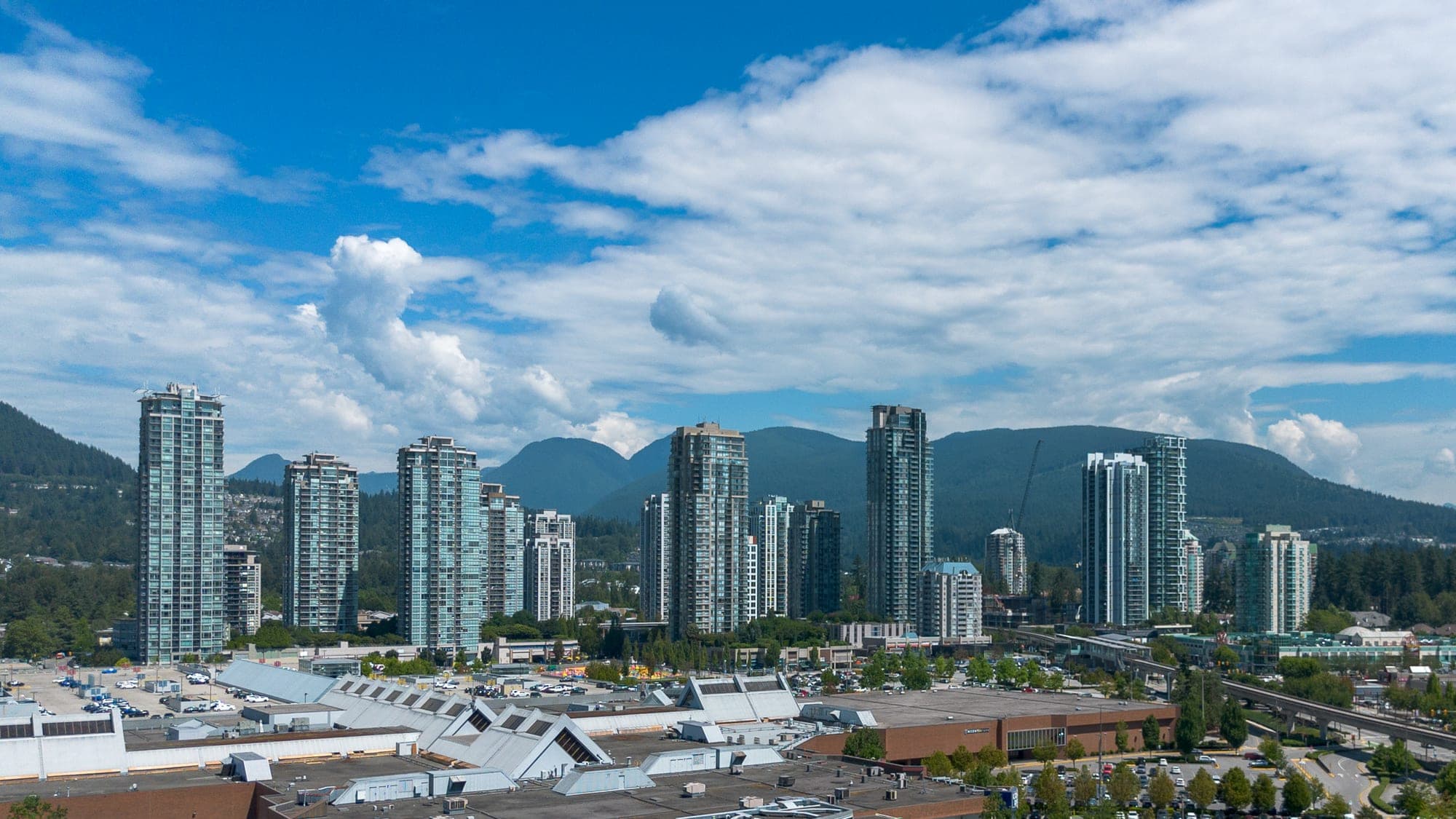
Vancouver vs Coquitlam
Quick answer
Coquitlam is roughly 18% cheaper on CMHC two-bedroom rent ($2,175 vs Vancouver's $2,644), greener, and home to Metro Vancouver's largest Korean community — with four SkyTrain stations since 2016. Vancouver is denser, more walkable, and closer to downtown. Families lean Coquitlam; downtown workers lean Vancouver.
Rent figures: CMHC Rental Market Survey, October 2025 · demographics: Statistics Canada Census 2021.
Vancouver vs Coquitlam is the classic city-versus-family-suburb choice on the northeast side of Metro Vancouver. Vancouver is the dense, walkable, expensive core; Coquitlam is the quieter, greener, more affordable suburb that became genuinely transit-connected in 2016, when the Evergreen Extension of the Millennium Line opened four SkyTrain stations across the city. For newcomers with kids and a car, Coquitlam often wins; for singles and couples working downtown, Vancouver usually does.
Vancouver has about 662,000 residents in 115 km²; Coquitlam has about 149,000 spread across 122 km² — similar area, a quarter of the population, which means far lower density, more green space, and more large-lot houses. Coquitlam is the Korean capital of Metro Vancouver: roughly one in seven residents speaks Korean as a mother tongue — the highest concentration in the region — and the Korean food and retail scene along North Road is deep and authentic. Coquitlam's foreign-born share is 45.9% versus Vancouver's 41.8%.
Housing is where the decision usually gets made. A CMHC two-bedroom averages $2,175 in the combined Tri-Cities zone that includes Coquitlam versus $2,644 in the City of Vancouver — about 18% cheaper — and one-bedrooms run $1,708 versus $1,862. The bigger gap is detached houses: Coquitlam's Burke Mountain and Westwood Plateau offer newer family homes at prices well below Vancouver's Westside. In return you trade a 40–45 minute SkyTrain commute to downtown for the walk-everywhere convenience of the city.
Side-by-side data
Every row is cited. Scroll horizontally on mobile.
| Metric | Vancouver | Coquitlam |
|---|---|---|
Population Stats Canada 2021 Census | 662,248 | 148,625 |
Land area | 115.18 km² | 122.3 km² |
Median age | 40 | 42.2 |
Foreign-born | 41.8% | 45.9% |
Top non-English language | Cantonese | Korean |
Median household income Stats Canada 2020 income year | $80,500 | $98,500 |
1BR rent (CMHC avg) CMHC purpose-built rental | $1,862 | $1,708 |
2BR rent (CMHC avg) | $2,644 | $2,175 |
Transit pass (monthly) | $117 | $212 |
Annual rainfall | 1189 mm | 1833 mm |
Walk Score | 80 | 51 |
SkyTrain lines | Expo Line · Millennium Line · Canada Line | Millennium Line (Evergreen Extension) |
Safety (CSI, 2024) Statistics Canada Crime Severity Index · lower is safer | 83.5 ▴ +8.5 vs national | 83.5 ▴ +8.5 vs national |
Who each city is for
Pick Vancouver if…
Vancouver is right for you if: you work downtown or on the Westside and want a short commute; you want to live without a car; you value walkable neighbourhoods, cafés, and the seawall; or you're a single or couple who prioritises location over square footage.
Read the full Vancouver guide →Pick Coquitlam if…
Coquitlam is right for you if: you have a family and want a house with a yard and mountain views; you're part of (or want to be near) Metro Vancouver's largest Korean community; you want SkyTrain access at suburban prices; or you want trailheads on Burke Mountain and Mundy Park ten minutes from your door.
Read the full Coquitlam guide →Decision
Which one should you pick?
For most newcomer families, Coquitlam is the pragmatic pick — roughly 18% cheaper apartment rent, far cheaper detached houses, strong SD43 schools, and, since 2016, real SkyTrain access. The trade-off is the commute: 40–45 minutes to downtown Vancouver on the Millennium Line versus 15–25 from most of Vancouver proper. If your job is downtown and you'd rather walk than drive, Vancouver's premium buys back your time. If you want space, nature, and a Korean-Canadian community with SkyTrain, Coquitlam is hard to beat.
Vancouver vs Coquitlam — what people usually ask
Is Coquitlam cheaper than Vancouver?
Yes. CMHC two-bedroom rent is about $2,175 in the Tri-Cities zone (which includes Coquitlam) versus $2,644 in the City of Vancouver — roughly 18% less. One-bedrooms are $1,708 versus $1,862, and detached houses are dramatically cheaper.
How long is the commute from Coquitlam to downtown Vancouver?
About 40–45 minutes by SkyTrain from Coquitlam Central on the Millennium Line, transferring at Commercial–Broadway to the Expo Line for downtown. Driving is typically 45–70 minutes in rush hour.
Does Coquitlam have SkyTrain?
Yes. The Evergreen Extension of the Millennium Line opened in 2016 with four stations serving Coquitlam — Burquitlam, Coquitlam Central, Lincoln, and Lafarge Lake–Douglas — plus connections through Port Moody. It transformed Coquitlam from a car-dependent suburb into a transit-accessible one.
Which is better for families?
Coquitlam, for most. Cheaper houses, more space, mountain access, and strong SD43 schools. Vancouver makes sense for families committed to a specific Westside catchment or anchored to a downtown job.
Dig deeper